Ask for the registered phase plan
Confirm the exact land, towers, amenities, utilities, access points, and completion date tied to the RERA phase.
Why corner-home planning is the real differentiator, and how the 80% open-space single-phase parcel translates into daily life.
The master plan is what makes Amberstone Vectra different from a mainstream Sarjapur Road launch. The entire 8+ acre parcel is registered under a single Karnataka RERA filing - there is no "phase 1 vs phase 2" carve-out, no future-phase construction that will surround early residents, and no shared-amenity arrangement with a wider masterplan. What you see on the master plan is what is being delivered together by April 2028. Aparna Wonder Woods is useful for the site-planning lens because buyers should read open space, movement, parking, and amenity placement as everyday-use details, not brochure decoration.
The defining design choice is corner-home planning. Each of the four towers has 4 units per floor, and every one of those units is a corner home with three-sided exposure. There are no middle units that get light from only one face. Combined with 100% Vastu compliance across all 536 residences and an 11 ft floor-to-ceiling height, this is a meaningfully different stack-plan signature from mainstream Sarjapur Road high-rises.
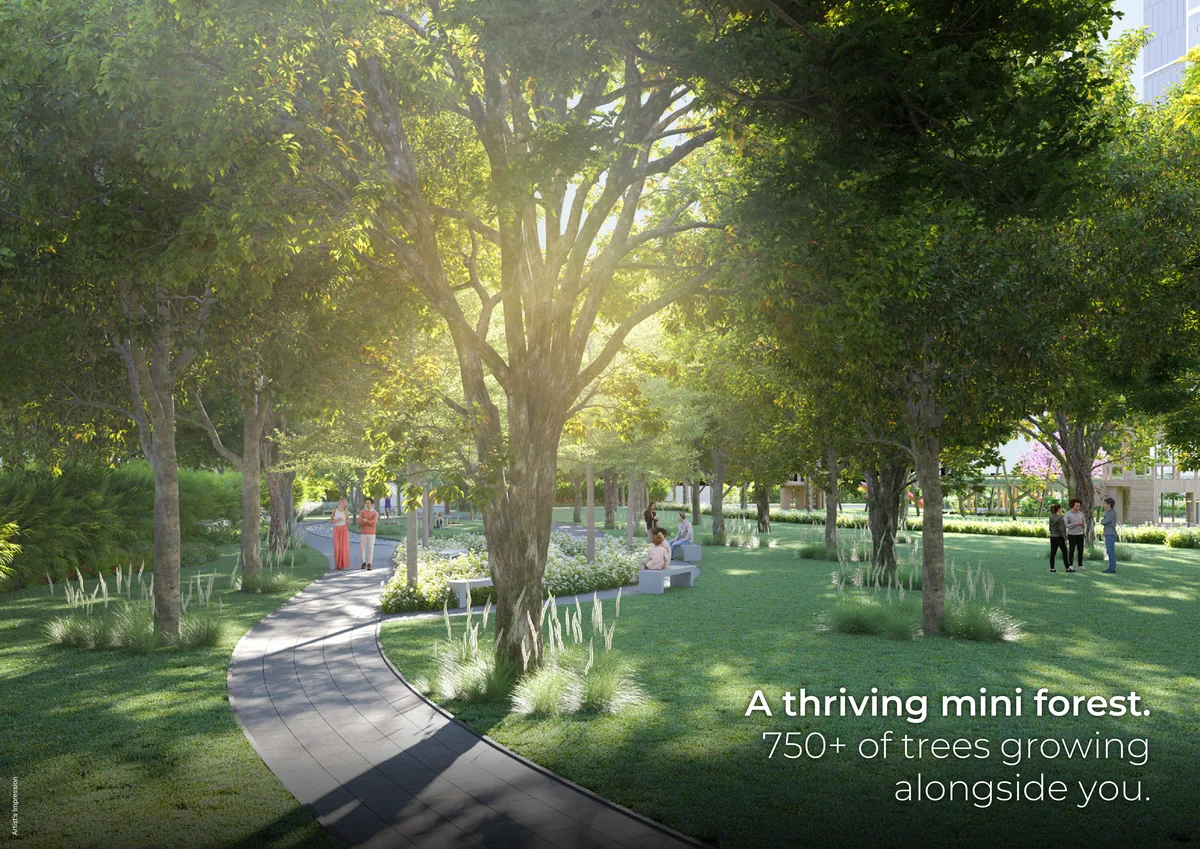
Density is moderate by Bengaluru high-rise standards: 536 units on 8+ acres, with 80% of the land kept as open space. The 38,000 sqft 5-level clubhouse, the 750+ tree Mini Forest by Dhruva Landscape Architects, the sports courts and pools all sit on the remaining 20% built footprint. The planning brief explicitly prioritises tree canopy over built density.
Single-phase delivery is the operational story. The four towers (A, B, C, D) are designed for coordinated handover at April 2028 - Amberstone Properties' first 4-tower simultaneous delivery. Confirm with the sales counter how the handover sequence within April 2028 will run (which tower opens first), how snag-list closures will be managed across the four towers, and how the 38,000 sqft clubhouse and 60+ amenities will be commissioned alongside the residential handover.
Monolithic shear-wall construction designed for seismic compliance is the structural choice. That matters for a 34-floor stack and is a step up from conventional RCC frames. Combined with the on-site STP, rainwater harvesting, 100% power backup with 50% diversity, sheltered car parking, and 24x7 security / CCTV, the master plan is laid out as a complete operational system rather than a render set.
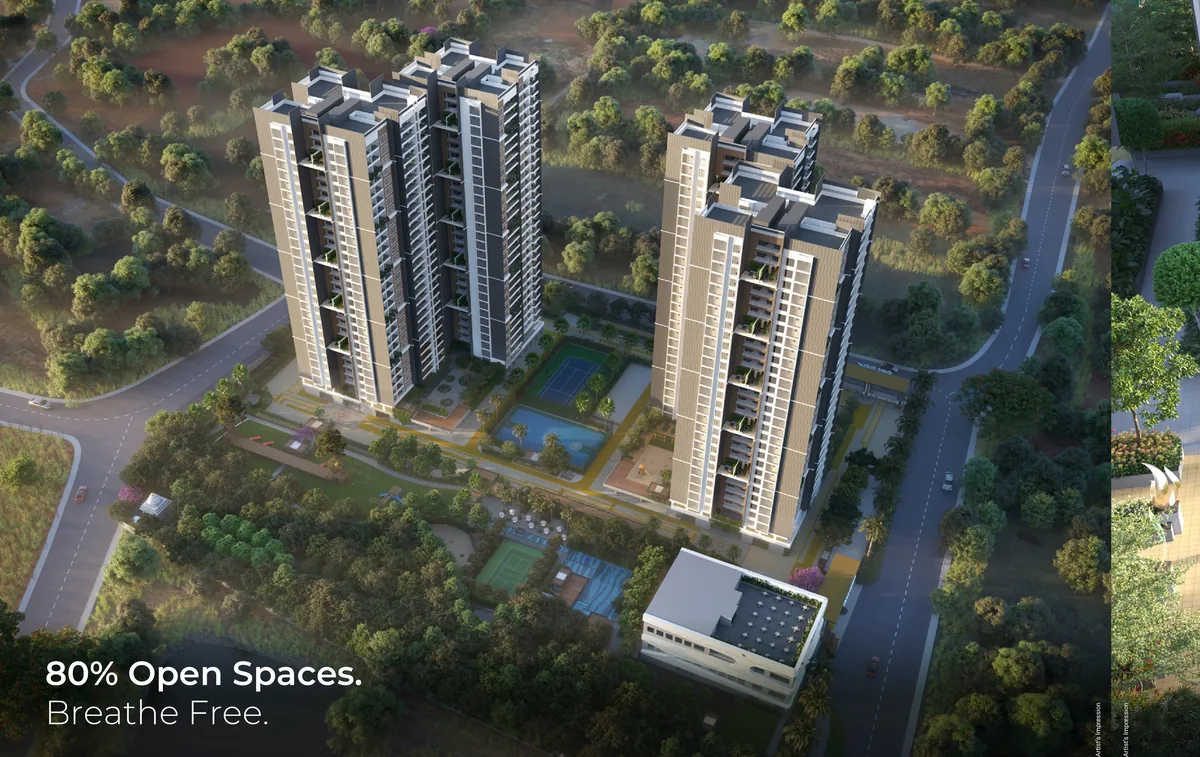
The three dratowers below are the working schematics buyers should ask for at the sales office. The master plan shows wing placement, internal roads, the central green, and the amenity legend. The landscape plan zooms in on how greens, water features, sports courts, and the clubhouse zone are stitched together. The key plan places the site against its wider regional context so the location story can be tested against the aerial reality rather than the brochure render.
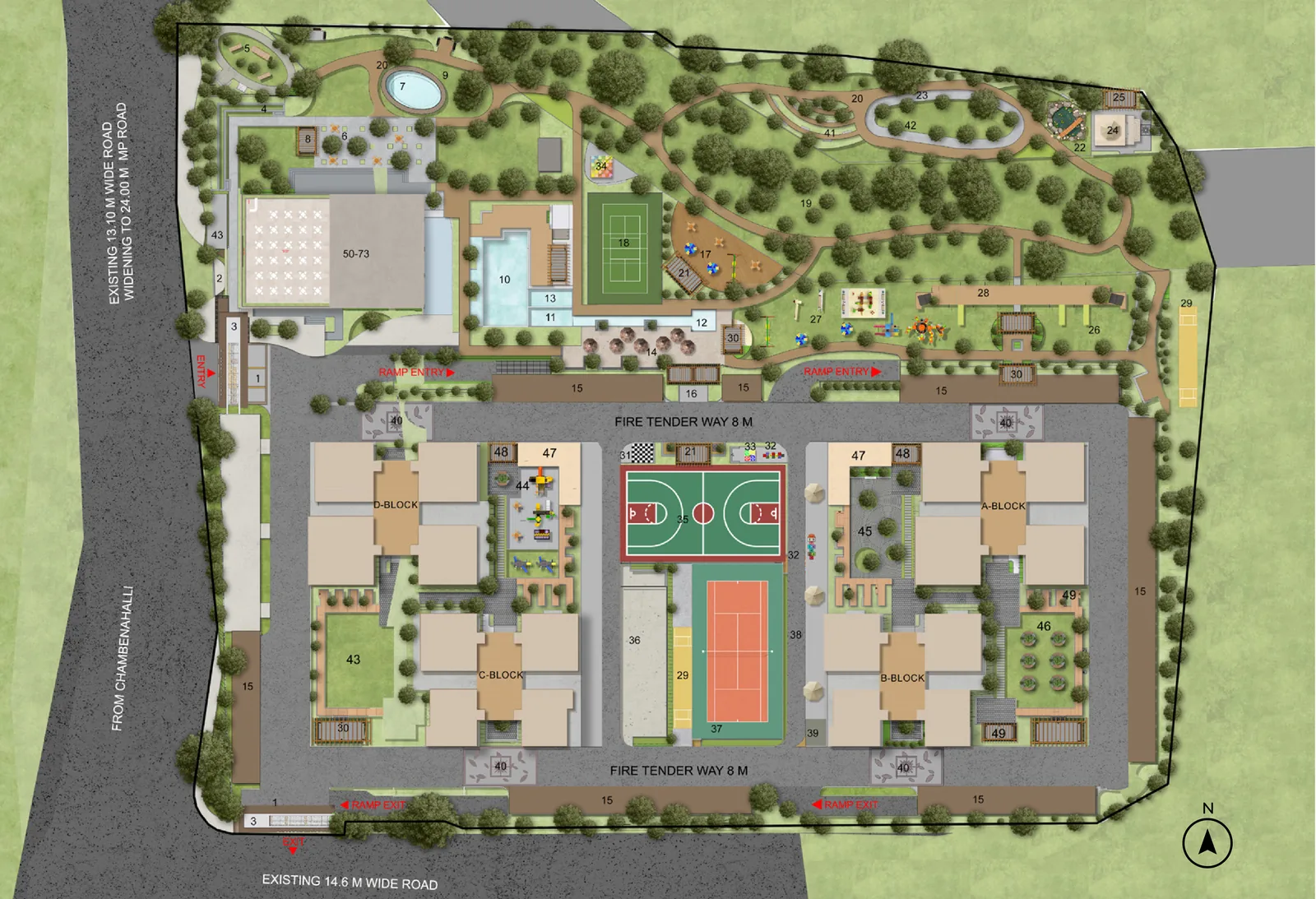
Read the master plan as an operations document. Confirm which towers face the central plaza versus the service edge, where the residential and visitor gateways sit, how the school bus bay and tower drop-offs are separated, and where the DG yards and organic waste converter (OWC) are placed relative to the wing you are considering. A wing that looks attractive on a stack sheet can sit next to service traffic on the master plan.
The landscape plan answers daily-use questions: how far residents in each wing walk to the leisure pool, multi-sport courts, or amphitheatre, whether children's pools and play parks sit away from sports-court noise, and where the indoor sports block lands relative to the clubhouse plaza. Ask the sales team to mark the tower you are considering on this plan and walk through a typical weekend route on paper before committing.
The key plan is the location reality check. The Karnataka RERA filing covers the full 8+ acre single-phase parcel - there are no Phase 02 / Phase 03 carve-outs. Use this drawing to confirm what is built, what is agricultural, and which approach road actually reaches the residential gateway today. View and noise assumptions tied to adjacent parcels should be confirmed via your own site walk; the Chambenahalli context is still maturing socially.
| Planning item | Verified figure | Buyer question |
|---|---|---|
| Parcel | 8+ acres, single phase, single RERA filing, 80% open space | Match the registered Survey No. 131 against the title chain through your lawyer. |
| Residential towers | 4 towers (A, B, C, D); 134 units per tower; 4 corner-home units per floor | Which tower has your configuration (A/D for 3.5 and 4 BHK Premium, B/C for 3 BHK)? |
| Tower stack | Basement + Stilt + ~29 habitable floors; 11 ft floor-to-ceiling height | How many passenger lifts, service lifts, fire lifts and refuge floors per tower? |
| Unit count | 536 corner-home residences total, every unit Vastu-compliant with three-sided exposure | Get the RERA carpet area and floor-rise premium for your specific unit number. |
| Parking | Sheltered car parking; basement levels per the sanctioned plan | How are visitor parking, EV charging, and service access organised? |
| Amenities | 38,000 sqft 5-level clubhouse + 60+ amenities + 750+ tree Mini Forest | Confirm the handover schedule for the clubhouse and Mini Forest alongside tower handover. |
Density should not be judged only by acres. A 8+ acre phase with 536 apartments can still feel dense if tower placement, lift capacity, clubhouse sizing, parking movement, and open-space distribution are not handled well. Conversely, a tall-tower plan can preserve more ground-level open space if vehicles are pushed into basements and towers are placed around a usable green core.
The 3B+G+46 structure suggests a vertical community. Tall towers often create better views and free ground area, but they also concentrate residents into lift cores. Buyers should ask for technical comfort: number of lifts per tower, service lift size, fire lift provision, refuge floors, staircase widths, fire tender access, and generator backup for essential services. These details rarely appear in glossy pages, yet they determine daily comfort and safety.
Internal movement is just as important. A large township should separate resident vehicles, visitors, pedestrians, service vehicles, emergency vehicles, and construction traffic wherever possible. If the same internal roads serve school buses, delivery vehicles, residents, visitors, and future-phase construction, bottlenecks can appear at the gate and basement ramps. Ask how access will work during both construction and final operation.
The central green is meaningful only if it is genuinely accessible, not merely a view corridor between towers. Buyers should understand whether the green is a landscaped park, a circulation spine, a clubhouse forecourt, or a set of smaller lawns. A strong green core supports walking, children’s play, informal community life, and resale appeal. A weak green core becomes a visual filler that residents admire from balconies but rarely use.
Parking is another planning test. Three basement levels can keep the ground more pedestrian-friendly, but basement operations must be convenient. Check ramp placement, tower-to-parking distance, visitor bays, EV charging allocation, ventilation, security, and waterlogging safeguards. In a peripheral township where most households may own cars, parking design is not a backend issue; it is part of everyday livability.
The amenity programme spans a 38,000 sqft 5-level clubhouse and 60+ amenities, stacked vertically (Ground, First, Second, Third, Terrace) rather than spread across multiple buildings. That keeps every amenity within walking distance of every tower lobby. The amenity count is meaningful, but the planning logic - stacking by activity type to reduce noise conflict between active and quiet zones - is the real signal.
Weekly-use amenities deserve priority in master-plan evaluation. Walking tracks, shaded seating, children’s play, elderly seating, fitness areas, swimming pool, indoor games, co-working, convenience retail, and sports courts will affect daily satisfaction more than occasional features. Buyers should ask where these are placed, whether younger children can reach them safely, whether senior citizens have quieter zones, and whether sports courts are far enough from residential blocks to reduce noise.
The clubhouse should be read as a capacity asset. Ask how many residents the gym, pool, banquet hall, indoor games, and co-working areas are designed for. Ask whether access will be phased as towers are handed over. Ask whether clubhouse maintenance is included in common charges or collected separately. In a 536-unit Project, even a large clubhouse needs clear operating rules to avoid overcrowding.
Green space should be tested for climate and use. Bangalore’s sun, monsoon, and dust conditions mean open areas need shade, drainage, hardy landscaping, seating, lighting, and maintenance access. A render can show lush lawns, but a real township needs soil depth, irrigation, STP reuse strategy, and a landscape maintenance budget. If treated water is used for gardens, the STP capacity and odour management become part of the green-space story.
The strongest master plan would make daily movement pleasant even without using the clubhouse. A resident should be able to walk, sit, drop children to play areas, reach the lobby, access parking, and receive deliveries without friction. If the master plan depends entirely on spectacular amenities while ignoring everyday paths, it will feel weaker after the novelty fades.
Confirm the exact land, towers, amenities, utilities, access points, and completion date tied to the RERA phase.
Understand which towers and amenities come first, and how residents are protected while later areas remain under construction.
Water, STP, power backup, solid waste, stormwater, basement drainage, and fire systems must match a high-rise township scale.
Large amenities and landscaped acreage can improve lifestyle, but they also create long-term operating costs.
The main master-plan risk is that buyers mentally purchase the full finished township while the legal agreement covers a narrower phase. The difference is not a technicality. If a later school, hospital, retail street, or second clubhouse is shown in a broad vision deck but not committed in Project documents, the buyer should not value it as guaranteed. It can be treated as upside, not as a booked benefit.
Another risk is construction adjacency. Early residents in large townships often live beside active construction for years. This can affect dust, noise, road cleanliness, visitor experience, and view. The question is not whether later phases will happen; it is how construction access, worker movement, material storage, and safety separation will be managed after early possession.
Utility risk is especially important in Sarjapur. A high-rise township needs water sourcing, storage, recycling, stormwater planning, sewage treatment, fire water, and power backup that are credible at scale. Cauvery Stage VI may improve the long-term water picture for peripheral Bengaluru, but possession-day reliability still depends on project-level planning and government execution timelines. Buyers should ask for written water source assumptions rather than accepting a generic “24x7 supply” line.
Maintenance is the ongoing cost of premium amenities. A 38,000 sqft 5-level clubhouse, multiple sports courts, landscaped greens including the 750+ tree Mini Forest, elevators in 34-floor towers, security and CCTV systems, pumps, on-site STP, and basement infrastructure all carry monthly operating costs. The first-year maintenance is bundled into the all-in price, but year 2+ rates and the eventual sinking-fund contribution should be confirmed with the sales counter before booking. Ask what is included, what is excluded, and how maintenance transitions from the developer to the Resident Welfare Association after handover.
The final master-plan view is balanced. Amberstone Vectra’s scale is a genuine differentiator, and if executed well it can create a destination community in Sarjapur. But the buyer should read the master plan like an operations blueprint. A good render shows aspiration; a good set of approvals, phasing notes, utility plans, and maintenance assumptions shows deliverability.
A master plan should be evaluated not only for design but for operations. After possession, residents experience the project through gates, guards, roads, basements, lobbies, lifts, waste collection, delivery movement, school buses, water pressure, power backup, cleaning, landscape maintenance, and complaint response. If these systems work, the township feels premium. If they do not, even a beautiful site plan feels tiring.
Gate design is a daily friction point. A large township needs enough lanes for residents, visitors, cabs, deliveries, school buses, emergency vehicles, and service entries. If every movement passes through the same narrow checkpoint, peak-hour delays become a resident issue. Buyers should ask whether entry and exit are separated, whether there are service gates, and how security screening is balanced with flow.
Basement design is another operational layer. Three basement levels can preserve the ground plane, but residents need safe, well-lit, ventilated, and navigable parking. Wayfinding, lift-core proximity, drainage, fire safety, EV charging, visitor parking, and delivery parking all matter. In heavy rain, basement drainage and pump backup become more than technical details.
Waste management should be planned for the full resident population. A 536-unit Project generates significant daily waste, packaging, garden waste, and festival/event peaks. Ask where waste is segregated, how service vehicles move, how odour is controlled, and whether the system is separated from resident leisure paths. A premium township should make waste invisible without making operations unsafe or impractical.
Delivery and visitor management will shape the first resident impression. By 2031, app-based deliveries, cabs, domestic help, service technicians, and guests will be constant. A township must decide what enters the basement, what stops at a delivery room, how parcels are stored, and how residents are notified. These details affect security and convenience in equal measure.
Association handover is the final operating question. Large townships can have complex governance because towers are delivered in phases. Buyers should ask how maintenance is billed before all towers are ready, when resident bodies form, what the developer controls after handover, and how shared township amenities are governed across phases. A master plan is successful when its governance is as clear as its geometry.
| Operating system | Why it matters | Ask this |
|---|---|---|
| Gate and visitor flow | Prevents daily peak-hour friction | How many resident, visitor, service, and emergency lanes are planned? |
| Basement management | Controls convenience and safety | How are ventilation, drainage, EV charging, and lift access handled? |
| Waste and service routes | Keeps township clean and livable | Where do service vehicles move and how is odour controlled? |
| Delivery handling | Balances convenience and security | Are parcels centralized or delivered tower-to-tower? |
| Association handover | Affects long-term maintenance quality | How will costs and control shift as phases are delivered? |
Ask the sales office to mark the exact Project boundary on the master plan. Then ask which residential towers, roads, open spaces, clubhouse areas, sports courts, parking structures, water systems, and utility zones are included in that boundary. This turns the master plan from a broad township dream into a practical purchase map.
Ask when each major amenity becomes usable. If tower possession begins before the clubhouse, central green, pool, or sports courts are ready, the first residents may live in an incomplete environment. This is common in phased townships, but buyers should know it before paying. A written amenity schedule is better than a verbal assurance.
Ask how future construction will be separated from occupied towers. A clear answer should cover construction gates, worker movement, material storage, dust control, noise timings, safety barricades, and resident-road separation. In a large township, this issue can affect quality of life for years after the first handovers.
Ask about emergency access. Tall towers need fire-tender access, refuge planning, fire lifts, hydrant systems, evacuation routes, and enough internal-road width. Buyers do not need to become fire engineers, but they should confirm that emergency planning is treated as a core high-rise requirement and appears in approvals.
Ask about stormwater and basement drainage. Sarjapur and East Bangalore can see heavy rain events, and three basement levels need reliable drainage, pumps, backup power, and maintenance protocols. A dry and safe basement is part of premium living, especially when parking and tower access depend on it.
Ask about long-term township governance. If later phases share some amenities and roads with Project, who pays for what? If some amenities are township-level and others phase-level, how are costs allocated? If commercial or retail parcels arrive later, how will traffic and access be managed? These governance questions are part of the master plan even if they are not drawn as shapes.
A practical way to use this master-plan page is to turn it into a meeting agenda. Instead of asking the sales team broad questions such as whether the project is good, ask for the exact phase boundary, amenity delivery, tower grouping, access, and utility planning details that affect your decision. Specific questions get specific answers, and specific answers are easier to compare with documents later.
Keep a written version history. Launch-stage projects change quickly: pricing slabs move, tower availability changes, RERA documents appear, payment schedules are refined, and amenity phasing becomes clearer. When you receive an answer, record the date, person, document name, and whether the answer came from a brochure, email, cost sheet, RERA upload, or verbal discussion.
Do not treat the first available unit as the only opportunity. Large projects often create urgency through EOI windows and preferred-unit availability, but the buyer still needs to check whether that unit fits budget, routine, floor preference, view, and resale logic. A less glamorous unit that fits the decision framework can be better than a rushed premium unit.
The key document for this page is the registered phase layout and amenity handover schedule. If that document is not yet available or does not answer the question clearly, mark the item as pending rather than resolved. Pending items do not always mean “do not buy.” They mean the buyer should avoid converting interest into a binding commitment until the uncertainty is proportionate to the amount being paid.
Every Amberstone Vectra decision also has an opportunity cost. The same budget may buy a smaller but more mature Whitefield resale, a different branded Sarjapur launch, a Whitefield apartment, a North Bangalore option, or a lower-risk ready home. The master-plan decision is stronger when the buyer can explain why Amberstone Vectra remains preferable after those alternatives are honestly considered.
The final master-plan takeaway is that township scale can create long-term value but only if phasing, operations, and governance are handled clearly. If that trade-off is acceptable, the next step is to ask how the first residents live while future phases are still under construction. If it is not acceptable, the buyer should pause, collect more evidence, or compare a different configuration or location before paying further.
Even after the broad master-plan questions are answered, micro-details deserve attention. Check walking distance from the tower lobby to clubhouse, visitor parking, children’s play, and the nearest internal convenience point. In a 8+ acre phase, a facility can be “inside the project” and still feel far for seniors, children, or residents carrying groceries.
Also ask how the township handles night lighting and passive surveillance. Large green spaces need enough lighting to feel safe without becoming harsh or wasteful. Paths should be visible from towers or active areas where possible. A master plan that works in daylight but feels empty after dark is weaker for families and senior residents.
Finally, ask how the plan handles pets, bicycles, service staff, and deliveries. These everyday movements rarely appear in launch renders, but they affect resident comfort. A mature township design gives each activity a sensible place rather than letting all movement compete on the same paths and roads.
An 8+ acre single-phase parcel at Survey No. 131, Sarjapura Hobli, Chambenahalli, with 4 towers (A, B, C, D), 536 corner-home residences, a 38,000 sqft 5-level clubhouse, a 750+ tree Mini Forest, and a 60+ amenity programme. Everything is under one Karnataka RERA registration (PRM/KA/RERA/1251/308/PR/051224/007269).
Four towers (A, B, C, D) each have Basement + Stilt + approximately 29 habitable floors with 4 corner-home units per floor - 134 units per tower. Every unit has three-sided exposure, 100% Vastu compliance, and 11 ft floor-to-ceiling height. The 3 BHK configuration sits in Towers B and C; the 3.5 BHK and 4 BHK Premium configurations sit in Towers A and D.
The 38,000 sqft 5-level clubhouse anchors the amenity programme - Ground (clinic, pharmacy, creche, multipurpose hall, mini-mart, admin), First (indoor games, billiards, squash, badminton), Second (art and craft, music, reading nook, classroom, co-working), Third (gym, yoga studio, spa, salon, jacuzzi, steam room), Terrace (BBQ counter, open lounge, guest rooms). Outdoor amenities include the 750+ tree Mini Forest, pools, tennis, basketball, pickleball, volleyball, squash, badminton, cricket pitch, skating rink, amphitheatre, pet park and meditation pavilion.
536 units on 8+ acres with 80% of the parcel kept as open space - moderate density for a Bengaluru high-rise. The single-phase delivery means no future construction will surround early residents.
The sanctioned plan is locked under Karnataka RERA registration PRM/KA/RERA/1251/308/PR/051224/007269. Any change requires a formal RERA amendment. The tower layout, unit count, configuration mix and 60+ amenity scope on the registered plan are the authoritative reference.
No. The 8+ acre parcel is single-phase - there is no Phase 02 or Phase 03 carve-out inside the same registration. The 38,000 sqft clubhouse, Mini Forest, sports courts and pools are all booked features within the registered project, not future-phase aspirations.