Before booking
Confirm the unit-specific cost sheet, refundability terms, payment into the disclosed RERA project bank account, and the Bajaj Housing Finance NOC to mortgage with the lender directly.
Move from brochure rates to livable commitments, then verify RERA and payment safety before any EOI.
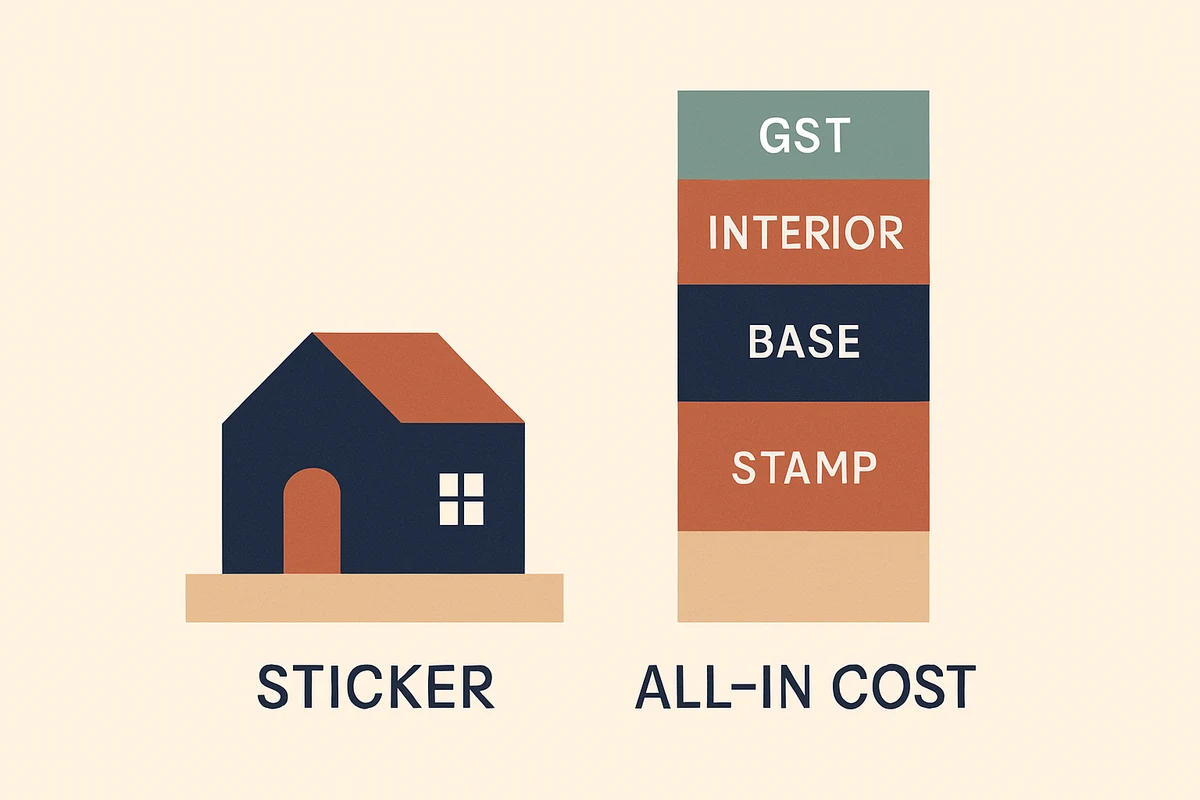
Amberstone Vectra's pricing structure is unusually clean for a Sarjapur Road pre-launch. The published ₹1.45 Cr to ₹2.85 Cr all-in range already bundles base price, PLC (floor / view / corner premium), FRC, parking, clubhouse fee, infrastructure, 1-year maintenance, GST and corpus. The only material additions on top of the sticker are Karnataka stamp duty and registration (~8.15% of agreement value) and your own interior fit-out. The cost-sheet base rate is ₹7,699 per sqft on SBA. When the budget line starts driving the decision, Aparna Wonder Woods keeps the discussion inside the same Bengaluru market, where final cost, payment timing, and exclusions matter more than headline rate.
For the entry configuration - 1,610 sqft 3 BHK at ₹1.45 Cr all-in - Karnataka stamp duty and registration add roughly ₹12 lakh, taking the on-road outlay to ~₹1.57 Cr before any interior spend. For a mid-band 3.5 BHK (around 2,150 sqft SBA), the on-road number lands close to ₹2.0-2.2 Cr. For the 4 BHK Premium at 2,890 sqft SBA / ₹2.85 Cr all-in, the on-road outlay is closer to ₹3.08 Cr. Add your interior budget on top - typically ₹15-20 lakh for a basic 3 BHK fit-out and ₹40 lakh+ for a fully kitted 4 BHK Premium.
The 4 BHK Premium ticket materially changes the risk profile. A buyer crossing ₹3 Cr on-road must plan down payment, rent through construction, the 16-milestone slab-linked disbursals, Bajaj Housing Finance pre-EMI, school fees, insurance, emergency corpus, and interiors without depending on rental income after the April 2028 handover. The 3 BHK in Towers B and C at ₹1.45 Cr keeps the same corner-home / Vastu / 11 ft attributes at a much lower commitment - many first-time buyers should consider whether the smaller plan in the same community is the more conservative purchase.
Treat every public price as indicative until it is matched against the unit-specific cost sheet for your exact tower, floor and unit number. Confirm what is bundled, confirm the 16-milestone payment trigger events, confirm the Bajaj Housing Finance NOC to mortgage and the pre-approved home-loan sanction directly with the lender, and confirm Karnataka stamp duty / registration through your lawyer. Spoken discounts are not enough for a two-year construction commitment.
A balanced pricing view: Amberstone Vectra is not a budget Sarjapur Road purchase. The buyer is paying for corner-home / three-sided exposure / 11 ft / 100% Vastu planning, the 750+ tree Mini Forest, the 38,000 sqft 5-level clubhouse, monolithic shear-wall construction, and Bajaj Housing Finance project funding. The value question is not "is it cheap?" but "is this planning DNA worth the planning premium versus a mainstream stack-plan Sarjapur Road launch at a similar ticket?"
| Configuration | SBA band | All-in price | Buyer note |
|---|---|---|---|
| 3 BHK (Towers B, C) | 1,610 – 2,102 sqft | From ₹1.45 Cr | The entry corner-home 3 BHK. Best fit for couples and small families who want Vastu-compliant three-sided exposure without crossing the 4 BHK ticket. |
| 3.5 BHK / 4 BHK Standard (Towers A, D) | 2,090 – 2,219 sqft | Mid range | The flexibility plan. The half-room reads as a study, prayer room, or compact fourth bedroom. Suits work-from-home or multi-generation households. |
| 4 BHK Premium (Towers A, D) | 2,677 – 2,890 sqft | Up to ₹2.85 Cr | The largest format with four corner-home bedrooms, 11 ft ceilings, and full utility / staff zoning. Long-term primary residence rather than tactical investment. |
Read the price sheet configuration by configuration, not as one blended range. The 3 BHK at ₹1.45 Cr is competing with other Vastu-led corner-home 3 BHK launches on the Sarjapur Road corridor and with resale 3 BHK options in mature Sarjapur-Bellandur pockets. The 3.5 BHK is competing with mainstream 4 BHK Standard stack-plan apartments at a similar ticket. The 4 BHK Premium is competing with row villas, premium Sarjapur Road 4 BHK resale, and selected larger apartments in HSR / Bellandur.
The 3 BHK is often attractive because it keeps the ticket controlled while still delivering every corner-home / three-sided exposure / 11 ft / Vastu attribute the development is built on. The size band (1,610-2,102 sqft SBA) is generous for a 3 BHK at this ticket - confirm the carpet area for your specific unit (the RERA filing has the per-unit numbers) and whether the layout supports your furniture, work-from-home and storage needs.
The 3.5 BHK in Towers A and D needs a different lens. It is positioned as 4 BHK Standard marketing, so a buyer should confirm whether the half-room is genuinely a fourth bedroom or a study/prayer room that the family can use as such. Walk the plan with your furniture in mind before paying - the price delta over the 3 BHK is meaningful and the layout should justify it for your routine.
The 4 BHK Premium plans should be evaluated like long-term primary residences. The premium is not only in area; it is in arrival experience, view direction, three-sided exposure quality on a 2,800 sqft floor plate, parking allocation, lift access, and ability to host family. At this ticket size, the correct comparison may not be another Sarjapur Road apartment - it may be a row villa or a larger resale apartment in a more central Bengaluru pocket. Choose the project only if Vastu, corner-home and the 750+ tree Mini Forest are genuine decision drivers.
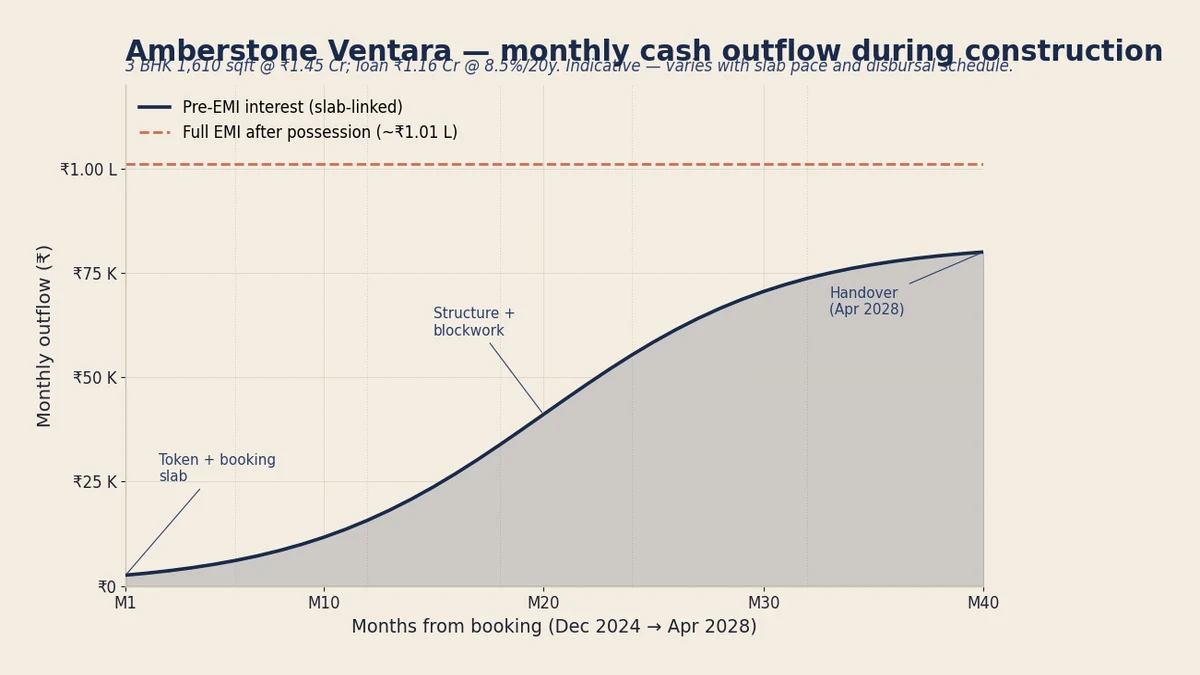
The most common affordability mistake is to calculate only the final EMI and ignore the path to April 2028. Amberstone Vectra follows a 16-milestone slab-linked payment plan: each milestone triggers a disbursement event from the home-loan lender, and Bajaj Housing Finance (the project funder) offers a pre-approved home-loan facility to buyers. That structure is better than a heavy upfront cash-flow, but it still creates a rising pre-EMI burden as construction progresses.
Use a 3 BHK example. A ₹1.45 Cr all-in unit on-road costs ~₹1.57 Cr after Karnataka stamp duty and registration. With a 20% down payment of ~₹29 lakh and a ~₹1.16 Cr loan at 8.5% over 20 years, the fully-disbursed EMI works out to approximately ₹1.01 lakh per month. For the 4 BHK Premium on-road at ~₹3.08 Cr, with 20% down (~₹62 lakh) and a ~₹2.46 Cr loan, the fully-disbursed EMI is approximately ₹2.13 lakh per month at the same rate.
Pre-EMI during construction starts low and ramps with each slab milestone. If the bank has disbursed ₹60 lakh by mid-2027, the interest-only pre-EMI at 8.5% is roughly ₹42,000 per month. If the disbursal rises to ₹1 Cr by late 2027, pre-EMI ramps to ~₹71,000. Add a current rent of ₹35,000-55,000 in Bellandur, Marathahalli, HSR or the wider ORR South tech belt, and the household's monthly housing outflow during the last year of construction can sit in the ₹1.0-1.35 lakh band - before any interior planning kicks in.
This does not mean the buyer should avoid the project. It means choosing the configuration that remains safe under stress. Run three scenarios: salary grows as expected, salary is flat for two years, and one income is interrupted for six months. If the home is still manageable in the second and third, the purchase is financially healthier. If the plan only works with promotions or resale appreciation, downsize to a configuration with a smaller ticket - the 3 BHK keeps every corner-home / Vastu / 11 ft attribute at a much lower commitment.
A second cash-flow issue is interiors. Plan for ₹15-20 lakh for a basic 3 BHK fit-out, ₹25-30 lakh for the 3.5 BHK, and ₹40 lakh+ for the 4 BHK Premium. The 1-year maintenance corpus is already bundled into the all-in price, but maintenance after year one and the eventual sinking-fund contribution should also be modelled into the long-term affordability picture.
Confirm the unit-specific cost sheet, refundability terms, payment into the disclosed RERA project bank account, and the Bajaj Housing Finance NOC to mortgage with the lender directly.
Match your unit number, tower, RERA carpet area, the 16 payment milestones, delay-compensation clauses, and the April 2028 possession date against the Karnataka RERA filing.
Bajaj Housing Finance offers a pre-approved home loan for buyers; confirm the sanction letter, disbursal schedule against the 16 milestones, processing fees, and whether any third-party lender option is acceptable to the project.
GST is already bundled into the all-in price published on Amberstone Vectra's cost sheet, so the headline ₹1.45-2.85 Cr range does not have GST as a separate line. Confirm this in writing on the unit-specific cost sheet before paying; the bundling is the developer's stated policy but each cost sheet should still reflect it line by line. Karnataka stamp duty and registration (~8.15%) sit outside the bundle and are paid at registration time - verify the exact percentage and the agreement value used as the base with your lawyer.
RERA is the central legal checkpoint. The project is registered with Karnataka RERA under PRM/KA/RERA/1251/308/PR/051224/007269, issued on 5 December 2024. Compare your sales conversation against the RERA record: project name (Amberstone Vectra Residences), promoter (Amberstone Properties), the 8+ acre single-phase land extent, the 4 towers, the 536-unit inventory, RERA carpet area for your specific unit, the project bank account, and the April 2028 completion date.
Bajaj Housing Finance Limited is the project lender and mortgage holder. Each buyer receives an NOC to mortgage from BHFL at the time of unit sale, and BHFL extends a pre-approved home-loan facility to buyers. Confirm the NOC, sanction letter, and disbursal commitments directly with BHFL - not only with the channel partner. If you want to use a different home-loan lender, confirm that the project is on that lender's approved list and that BHFL's mortgage allows third-party loans.
A price that looks good before RERA verification can look different after full documentation. Sanctioned plans define RERA carpet area differently from brochure super built-up area (the project's range is 996-1,652 sqft carpet across all configurations). The 16-milestone schedule should be read against your bank's disbursal protocol. The safest way to avoid surprise is to insist on a complete proforma cost sheet for the exact unit, tower, floor and view direction before emotionally committing.
A pricing page becomes useful only when it helps the buyer say no to the wrong unit. The most dangerous version of affordability is “the bank will approve it.” Bank eligibility is based on income, credit profile, property value, and policy. Household comfort is based on school fees, parent support, job volatility, rent, medical needs, childcare, travel, lifestyle, and emergency savings. Amberstone Vectra buyers should run a comfort test, not only an eligibility test.
Start with the down payment. A ₹2.1 Cr all-in 2 BHK with 80 percent funding still needs about ₹42 lakh in margin money, plus registration timing, interiors later, and liquidity buffer. A larger 3 BHK may require ₹55-70 lakh or more in upfront and staged equity depending on final cost. If the buyer empties emergency savings to make the booking, the purchase is fragile even if the long-term EMI looks manageable.
Next, test rent plus pre-EMI. Many buyers in this project will continue living near work or school until possession. That means the construction period is not free. If rent is ₹35,000 and pre-EMI rises from ₹25,000 to ₹80,000 over time, the household may experience a long period where monthly outflow feels like a second home. This is especially important for dual-income families planning children, elder care, or job changes before 2031.
Then test interest-rate sensitivity. A small change in rate can materially change EMI on a large loan. Buyers should not build the plan on the lowest promotional rate. Use a conservative rate and ask the banker whether the loan is repo-linked, how resets work, what processing fees apply, whether insurance is optional, and whether prepayment penalties are nil for floating-rate loans. The loan terms should be read as carefully as the project brochure.
Finally, test exit. If the buyer needs to sell before possession, who is the likely buyer? What transfer charges apply? Will the developer still have unsold inventory at comparable prices? Will a resale buyer prefer a lower floor, a different tower, or a more mature project? A launch buyer should not assume that a large supply base creates instant resale profit. Liquidity improves when the project shows visible progress and the location story strengthens.
The safe pricing conclusion is not to avoid higher-ticket homes. It is to match ticket size to resilience. If a 3 BHK is comfortable under stress, it may be a better long-term home than a tight 2 BHK. If the 3 BHK requires optimistic assumptions, a 2 BHK Large may be the financially healthier decision. The best unit is the one that leaves the buyer enough cash and calm to enjoy the home when it is finally delivered.
| Stress test | Question | Healthy answer |
|---|---|---|
| Emergency buffer | Can you hold 9-12 months of expenses after booking? | Yes, without depending on resale or family borrowing. |
| Rent overlap | Can you carry rent plus rising pre-EMI for several years? | Yes, under conservative income assumptions. |
| Interior budget | Is possession interior spend already planned? | Yes, as a separate future cash requirement. |
| Rate risk | Does EMI remain safe if rates move up? | Yes, with room in monthly surplus. |
| Exit risk | Can you hold beyond possession if resale is slow? | Yes, the plan does not require a quick flip. |
The first pricing document is the full cost sheet for the exact unit. It should show configuration, tower, floor, unit number, super built-up area, carpet area where available, base rate, base value, floor rise, PLC or view premium, parking, clubhouse, corpus, infrastructure charges, legal charges, maintenance deposits, utility deposits, GST, stamp duty estimate, registration estimate, and total payable amount. If any line item is missing or merged, ask for a clearer version. Vaishnavi AT-One Life Phase 4 is useful for cost discipline because a project decision should survive the full cost sheet, not only the first quoted rate or launch headline.
The second document is the payment schedule. A construction-linked plan can still be aggressive if milestones come quickly or if early slabs are front-loaded. Ask when each payment is due, what construction event triggers it, how much must be paid before Agreement of Sale, and how bank disbursal will be coordinated. A buyer paying rent should map every milestone to expected monthly outflow.
The third document is the EOI and booking terms. It should state refundability, deductions, timeline, adjustment against booking, what happens if RERA is delayed, what happens if preferred unit is unavailable, and whether the buyer can change configuration. If the EOI terms are informal, the financial risk is higher. A launch-stage expression of interest should be written tightly precisely because the project is still moving from marketing to documentation.
The fourth document is the draft Agreement of Sale once available. Price escalation clauses, delay compensation, cancellation clauses, force majeure wording, carpet area variation, possession definition, maintenance handover, and tax treatment should be reviewed by a lawyer. Buyers often read only the price schedule and miss clauses that affect exit, refund, or possession expectations.
The fifth document is the bank approval or project approval note. A bank’s willingness to fund the project helps, but the buyer should still ask whether approval applies to the exact phase and tower. Also confirm margin requirement, disbursal process, pre-EMI versus full EMI option, mandatory insurance claims, processing fees, and whether the quoted interest rate is final or subject to sanction conditions.
The sixth document is the buyer’s own affordability sheet. It should include down payment, registration timing, interiors, emergency fund, rent, pre-EMI, full EMI, maintenance, property tax after possession, and conservative income assumptions. This personal document is just as important as developer paperwork because it shows whether the project is not only buyable, but sustainable.
A practical way to use this pricing page is to turn it into a meeting agenda. Instead of asking the sales team broad questions such as whether the project is good, ask for the exact all-in cost, EOI, taxes, loan, and payment milestones details that affect your decision. Specific questions get specific answers, and specific answers are easier to compare with documents later.
Keep a written version history. Launch-stage projects change quickly: pricing slabs move, tower availability changes, RERA documents appear, payment schedules are refined, and amenity phasing becomes clearer. When you receive an answer, record the date, person, document name, and whether the answer came from a brochure, email, cost sheet, RERA upload, or verbal discussion.
Do not treat the first available unit as the only opportunity. Large projects often create urgency through EOI windows and preferred-unit availability, but the buyer still needs to check whether that unit fits budget, routine, floor preference, view, and resale logic. A less glamorous unit that fits the decision framework can be better than a rushed premium unit.
The key document for this page is the exact unit cost sheet and construction-linked payment schedule. If that document is not yet available or does not answer the question clearly, mark the item as pending rather than resolved. Pending items do not always mean “do not buy.” They mean the buyer should avoid converting interest into a binding commitment until the uncertainty is proportionate to the amount being paid.
Every Amberstone Vectra decision also has an opportunity cost. The same budget may buy a smaller but more mature Whitefield resale, a different branded Sarjapur launch, a Whitefield apartment, a North Bangalore option, or a lower-risk ready home. The pricing decision is stronger when the buyer can explain why Amberstone Vectra remains preferable after those alternatives are honestly considered.
The final pricing takeaway is that attractive base pricing can become a much larger livable commitment after statutory charges, interiors, and rent overlap. If that trade-off is acceptable, the next step is to run a household stress test before selecting the final configuration. If it is not acceptable, the buyer should pause, collect more evidence, or compare a different configuration or location before paying further.
All-in pricing ranges from ₹1.45 Cr (1,610 sqft 3 BHK in Towers B and C) to ₹2.85 Cr (2,890 sqft 4 BHK Premium in Towers A and D). The cost-sheet base rate is ₹7,699 per sqft on SBA.
The all-in figure is inclusive of base price, PLC, FRC, parking, clubhouse fee, infrastructure, 1-year maintenance, GST and corpus. Only Karnataka stamp duty and registration (~8.15% of agreement value) sit on top, plus your own interior fit-out.
Payment follows a 16-milestone slab-linked construction-linked plan, with each milestone triggering a disbursement from the home-loan lender. Bajaj Housing Finance Limited (the project funder) offers a pre-approved home-loan facility to buyers; third-party lenders can be used subject to approval.
A ₹1.45 Cr 3 BHK lands at ~₹1.57 Cr on-road after Karnataka stamp duty and registration. The 4 BHK Premium at ₹2.85 Cr lands at ~₹3.08 Cr. Add a separate interior budget of ₹15-40 lakh depending on configuration.
Unit-specific cost sheets are issued at booking and reflect your exact tower, floor, configuration and view direction. Until you receive yours, treat any circulating numbers as planning inputs rather than commitments.
Bajaj Housing Finance is the project funder and offers a pre-approved home loan, with the NOC to mortgage issued at unit sale. Buyers can also approach other approved lenders; confirm the project's approved-lender list and the BHFL mortgage's clauses on third-party loans in writing before applying.